
What’s wrong with algorithms?
Why do major social media companies force creators to stay small?
Why do they push them to create multiple channels in the AI era, when they already know everything about their users?
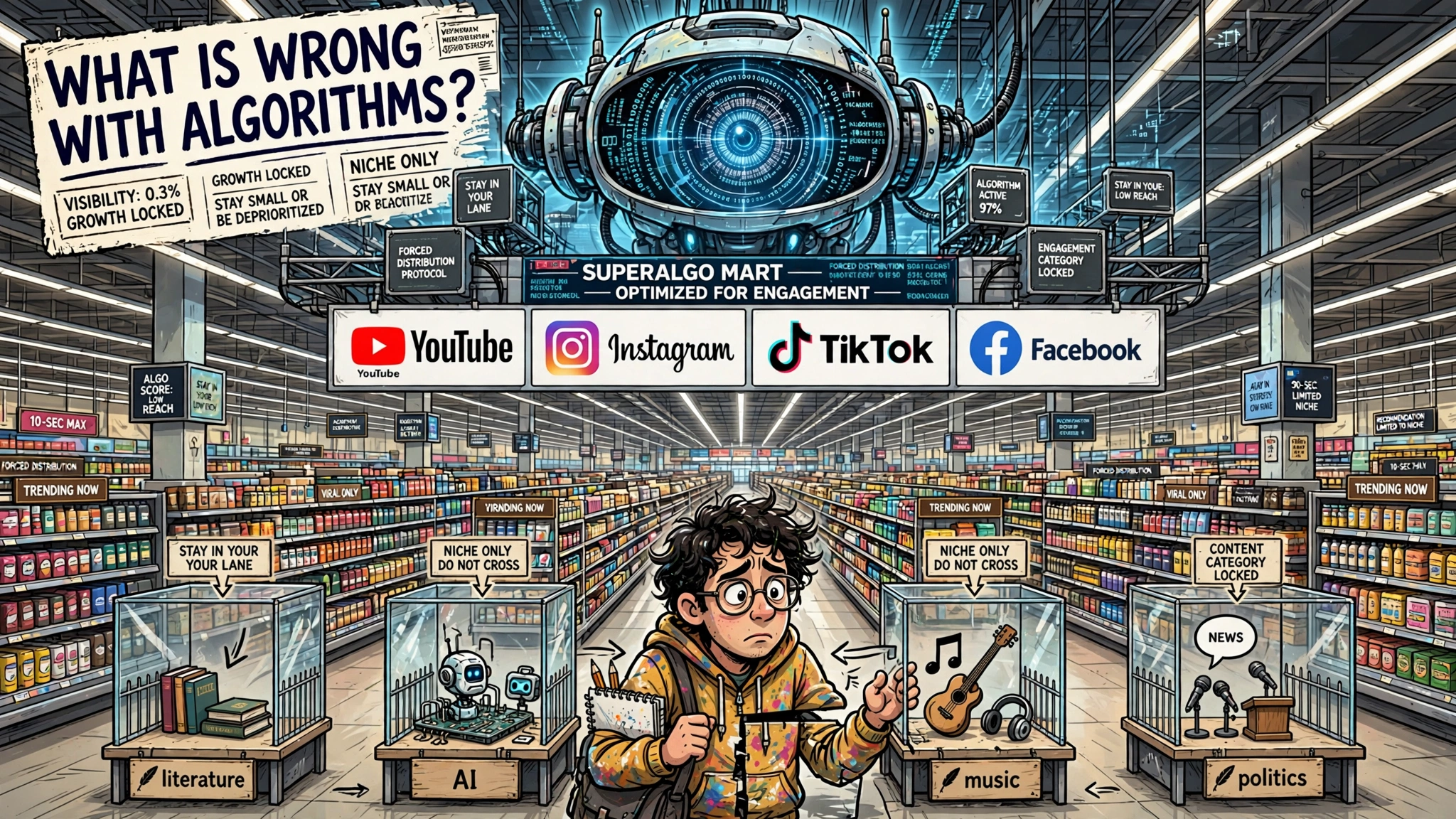
The major platforms—YouTube, Instagram, TikTok, Facebook—have been repeating the same mantra for years: pick a niche. The smaller, the better. The more precise, the better.
Be a specialized shelf in a massive supermarket. Don’t try to be the whole store. If you have too many interests, create separate channels. One for literature, one for AI, one for music, one for politics. Otherwise, the algorithm punishes you.
It sounds logical on paper. In practice, it’s a subtle form of control that deserves closer scrutiny.
What’s wrong with algorithms?
Algorithms aren’t neutral. They don’t “discover” valuable content. They optimize for clear metrics: time spent on the platform, retention, clicks, full views, and interactions. Anything that breaks the mold—a creator jumping from philosophy to video editing, or from comedy to political analysis—becomes hard to categorize. And what’s hard to categorize is hard to recommend.
The result? Platforms prefer predictability. A channel that consistently delivers the same type of content is a machine for generating steady engagement. A multi-passionate creator is an unknown variable. The algorithm doesn’t hate them on principle; it treats them as a risk.
The problem arises when this logic turns into a cultural norm. Creators begin to self-censor. They abandon topics that genuinely interest them so they don’t “confuse” the algorithm. Content becomes narrower, more repetitive, and more formulaic. True diversity is declining, even as the number of videos rises.
Why do companies push creators to stay “small”?
The short answer: because it’s more profitable for them.
When creators fragment into very narrow niches, the audience fragments too. A user interested in history, AI, and rock music has to follow three different channels instead of just one. They spend more time on the platform. They see more ads. They generate more data.
Furthermore, small niches are easier to monetize through targeted advertising. An advertiser selling video editing software knows exactly where to put their money. A channel that mixes philosophy with DIY projects and politics is harder to “sell” as ad inventory.
There is also a power dynamic at play. The more specialized creators are—and the more dependent they become on a single niche—the more vulnerable they are. If the algorithm changes or a niche becomes oversaturated, the creator is left without options. The platform retains control.
Why push them to create multiple channels in the age of AI?
This is where the most glaring contradiction arises.
It is 2026. Artificial intelligence can analyze in detail what each user watches, how long they stay on a video, what makes them scroll past, and which topic combinations they enjoy. Theoretically, platforms already possess all the data needed to personalize feeds at an individual level. A truly “intelligent” algorithm could say: “This user watches philosophy analyses, AI tutorials, and rock album reviews from the same creator. I can show them all of these, because the user knows what to expect from that creator.” In contrast, the current system still operates based on the logic of old, rigid labels. Creators are forced to split themselves into multiple digital identities just to remain “clean” in the eyes of the machine. It’s like having a highly advanced autonomous vehicle but forcing the driver to switch cars every time they want to drive on a different type of road.
Why? Because the business model hasn’t fundamentally changed. Platforms still profit from fragmented attention and time spent, not necessarily from the quality of the relationship between creator and audience. Multiple channels mean more touchpoints, more notifications, and more scrolling.
When they already know everything about users…
Exactly. They know. They know your preferences, your attention span, the times of day you’re active, what makes you hit “like,” and what makes you leave. Yet, instead of using this data to allow creators to be complex and authentic, they use it to force them to simplify.
That speaks volumes about priorities. It’s not just about “helping creators grow.” It’s about maintaining a system where the platform remains the indispensable intermediary and creators remain dependent on its rules.
What is to be done?
Algorithms are not laws of nature. They are design choices made by companies with clear interests. As long as those interests prioritize predictability and fragmentation over authenticity and human complexity, the advice to “stay small and specialized” will continue to prevail.
Creators with diverse interests are not a problem to be solved. They represent a human reality that the current system refuses to comfortably accommodate. And in the age of AI, this refusal is increasingly looking like a profitable anachronism.
The question is no longer just, “How do I adapt to the algorithm?”
The more important question is: “Why hasn’t the algorithm yet adapted to the complexity of the people it claims to serve?”